
 By Onyx Watson
Airport sustainability is no longer a separate environmental project. It is becoming part of daily operational planning, procurement, infrastructure development, and airline partnership discussions. For many airports, the main pressure is to reduce emissions on the ground, improve airside efficiency, and prepare for stricter environmental expectations, while continuing to support aircraft reliably every day.
The challenge is that infrastructure does not change overnight.
Full electrification remains an important direction for aviation ground operations. Fixed 400 Hz power, electric ground support equipment, charging infrastructure, energy management systems, and cleaner stand concepts are all part of the future airport. But in practical terms, many airports are still working through phased investment plans. Grid capacity may be limited. Charging points may not yet cover all operational areas. Remote stands, maintenance zones, cargo aprons, and temporary operating areas may still depend on mobile equipment. This is where the sustainability conversation needs to become more realistic.
Airports do not have to wait for a complete infrastructure transformation before reducing emissions. There are practical steps that can be taken now, especially in aircraft ground power. The key is to look at emissions reduction as a staged process, not a single final destination.
One of the first areas to assess is the age and efficiency of existing diesel ground power units. In many operations, older GPUs continue to provide essential support because they are mobile, familiar, and independent from fixed power systems. But older diesel platforms may no longer fit the expectations of modern airport sustainability strategies. They can become harder to justify in procurement discussions, environmental reporting, and long-term fleet planning.
Replacing outdated diesel equipment with lower-emission alternatives can be a meaningful step. A modern diesel GPU with Stage V / Tier 4 Final engine technology, for example, can help operators reduce the environmental impact of ground power while keeping the operational independence that many stands and service areas still require. This does not replace the need for electrification. It helps bridge the gap while infrastructure continues to develop. That bridge matters because airside operations are rarely uniform.
A major hub may have fixed power at many contact stands, but still rely on mobile GPUs for remote aircraft positions, maintenance activities, irregular operations, or construction phases. A regional airport may not yet have the capital or grid capacity for large-scale electrification. An MRO facility may need mobile power that can move between aircraft, hangars, and outdoor working areas. A ground handler may need equipment that supports mixed aircraft types under high turnaround pressure.
For these environments, sustainability must work in real conditions. A solution that looks good in a strategy document but does not support the daily operating model will not last.
Decision-makers should therefore evaluate aircraft ground power through several practical questions. Where is fixed power available today? Where is it planned next? Which stands still require mobile equipment? How many hours do diesel GPUs operate per day? Which aircraft types are supported? Are units oversized, outdated, or difficult to position? Is the equipment aligned with current emissions standards? Can it support cleaner operation where grid power is available? These questions often reveal that the best path is not a single equipment choice, but a balanced fleet strategy.
Fixed power should be used where infrastructure is mature and operationally reliable. Battery-powered equipment can be introduced where duty cycles, charging plans, and climate conditions are suitable. Lower-emission diesel and plug-in hybrid ground power units can support areas where independence, runtime, and flexibility remain critical. Together, these solutions allow airports to reduce emissions without weakening operational resilience.
Plug-in hybrid utility power functionality is especially relevant in this transition phase. When external utility power is available, the unit can operate with reduced fuel use. When it is not available, the same equipment can continue supporting aircraft independently. This gives airports and operators more flexibility as infrastructure develops stand by stand, rather than forcing a complete change before the airside environment is ready.
Compact design also plays a role in sustainable operations. Airports often focus on emissions, but space efficiency is part of the same discussion. Crowded aprons create movement challenges, increase operational friction, and affect safety. A compact mobile GPU that provides the required output without adding unnecessary equipment bulk can support cleaner, more organized, and more efficient aircraft servicing.
This is why modern ground power procurement should not be based only on output figures. Power rating matters, but so do emissions performance, footprint, maneuverability, serviceability, spare parts strategy, operating environment, and fit with future infrastructure plans. Airports need equipment that can serve today’s operation while remaining relevant as sustainability expectations continue to rise.
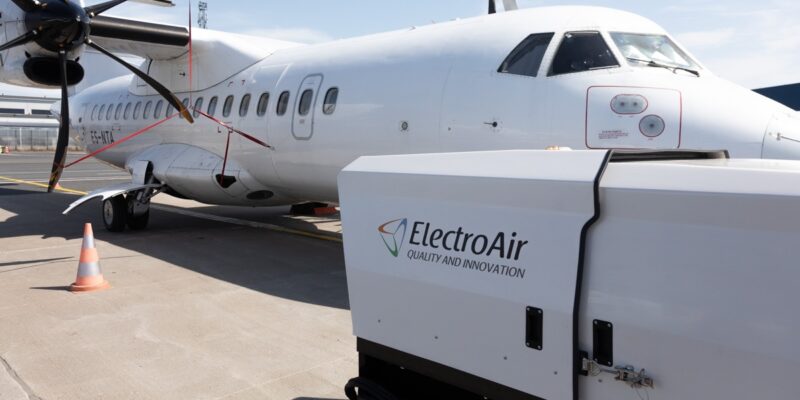
For a deeper look at how this transition applies to aircraft ground power, ElectroAir has outlined its view on lower-emission ground power and the practical role of modern mobile GPUs in supporting airport sustainability before full electrification is possible. The company’s ElectroAir APA-100 is one example of this approach, combining compact mobile design, Stage V / Tier 4 Final engine technology, and optional plug-in hybrid utility power for operators that need both reliability and a more future-conscious path.
The next stage of airport sustainability will be built through practical progress. Some changes will come from major infrastructure investment. Others will come from better equipment decisions, smarter fleet planning, and the replacement of outdated assets with more efficient alternatives.
For airports, the priority is not to choose between today’s operation and tomorrow’s goals. The priority is to connect them. Ground power is one of the places where that connection can already begin.